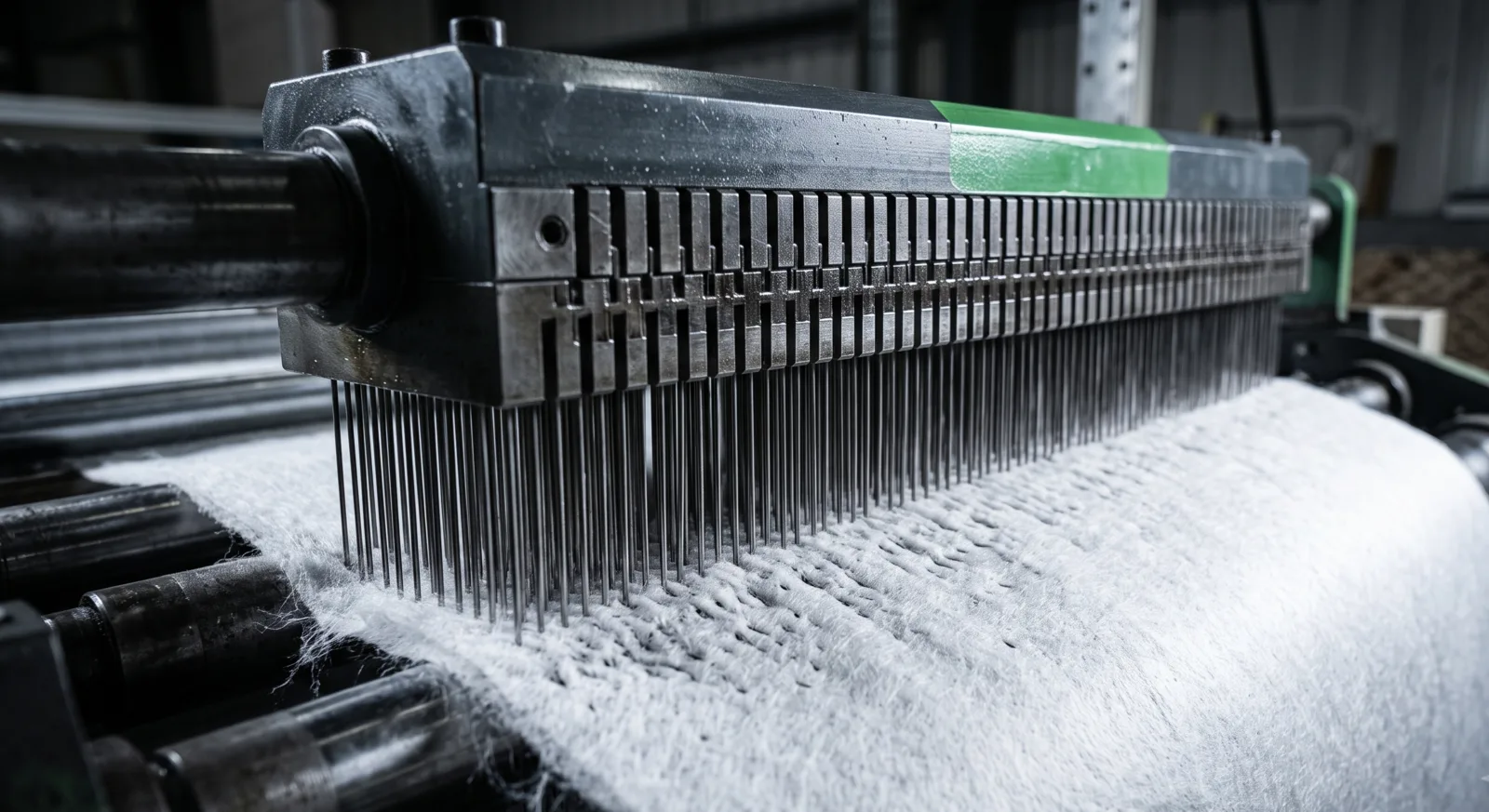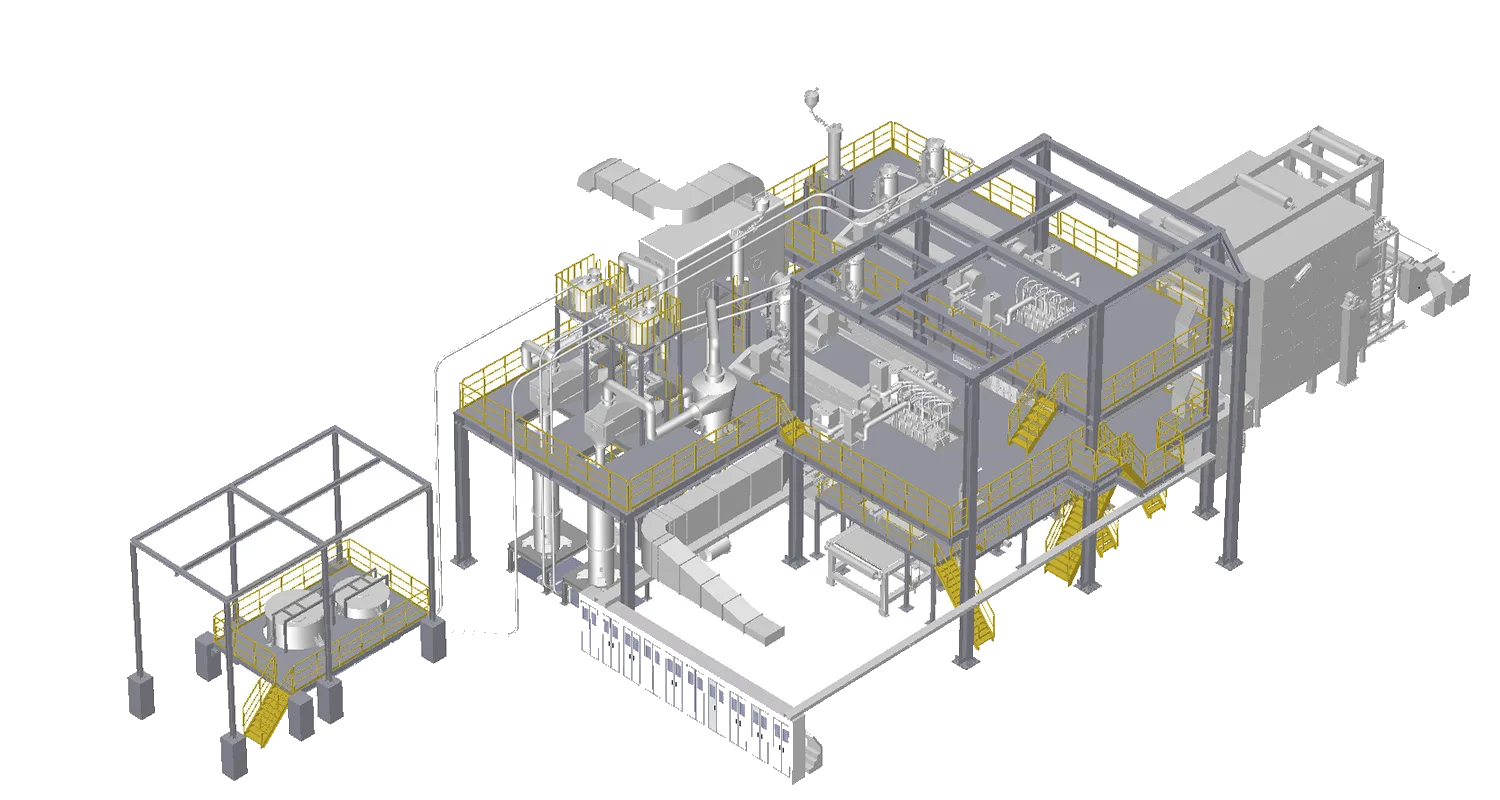
Fiber opening and blending machinery is the group of machines at the head of every nonwoven production line, doing two jobs at once: opening tightly compressed PET/PP fiber bales into loose tufts, and blending different fiber types into one uniform mixture before the material reaches the carding machine. This stage sets how even the fiber web can possibly be — and because the web is the foundation of the fabric, it also caps the basis-weight (GSM) consistency of the finished roll. A complete stage runs in five steps: bale opening → pre-opening → blending → fine opening → chamber blending.
Why bale fiber has to be opened and blended first
Staple fiber arrives as bales pressed under high pressure: the fibers are matted into slabs, mixed with dust and contamination, and often enough with a stray piece of metal that fell in during packing. Feed that block straight into a carding machine and four problems appear:
- The card clothing ends up doing the opening. Card wire exists to comb individual fibers parallel, not to break apart slabs of matted fiber — making it do that wears the wire fast, breaks teeth and pulls the re-clothing interval forward.
- Neps and thick spots. A tuft that reaches the card unopened will essentially never separate again; it stays in the web as a nep or a heavy spot and travels through the whole fabric.
- Off-target blend ratios. Main fiber and thermal bonding (low-melt) fiber have to be distributed evenly at the level of individual tufts; blend them loosely and the fabric bonds hard in places and delaminates in others.
- Metal contamination. One piece of metal entering the card can wreck an entire section of wire — a repair bill and downtime worth many times the magnet assembly that should have caught it.
The opening and blending stage handles all of this in advance: it breaks the bale into small tufts, pulls metal out magnetically, mixes to the recipe, and hands the card a fiber stream that is continuous and steady.
The machines in the opening and blending stage
The Zhentai opening and blending stage that Vina Nonwoven distributes follows the material flow, each step making the fiber one grade looser and more uniform.
1. Charter opening machine
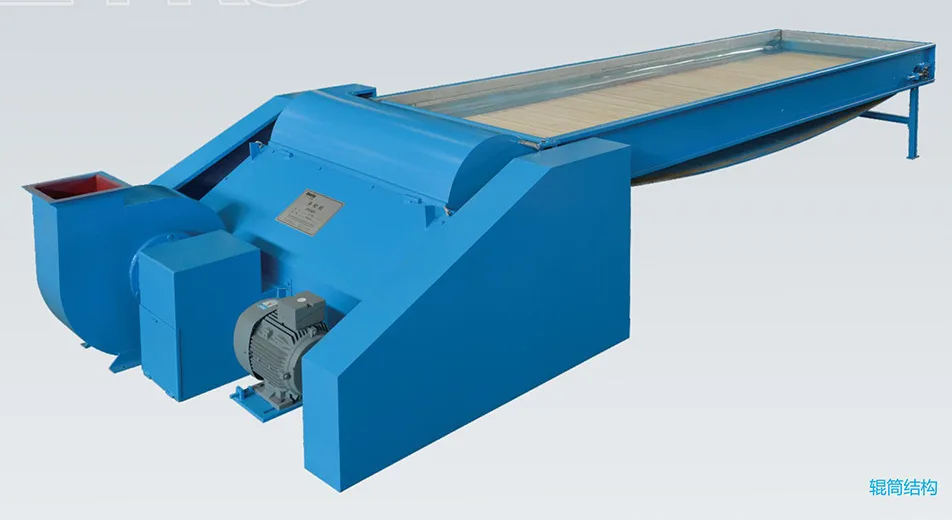
The charter opening machine is the first unit on the line: it loosens compressed fiber bales, tears them into small tufts, and feeds those tufts continuously and evenly downstream. A steady fiber flow from step one keeps the whole line running smoothly with fewer material jams.
2. Pre-opener
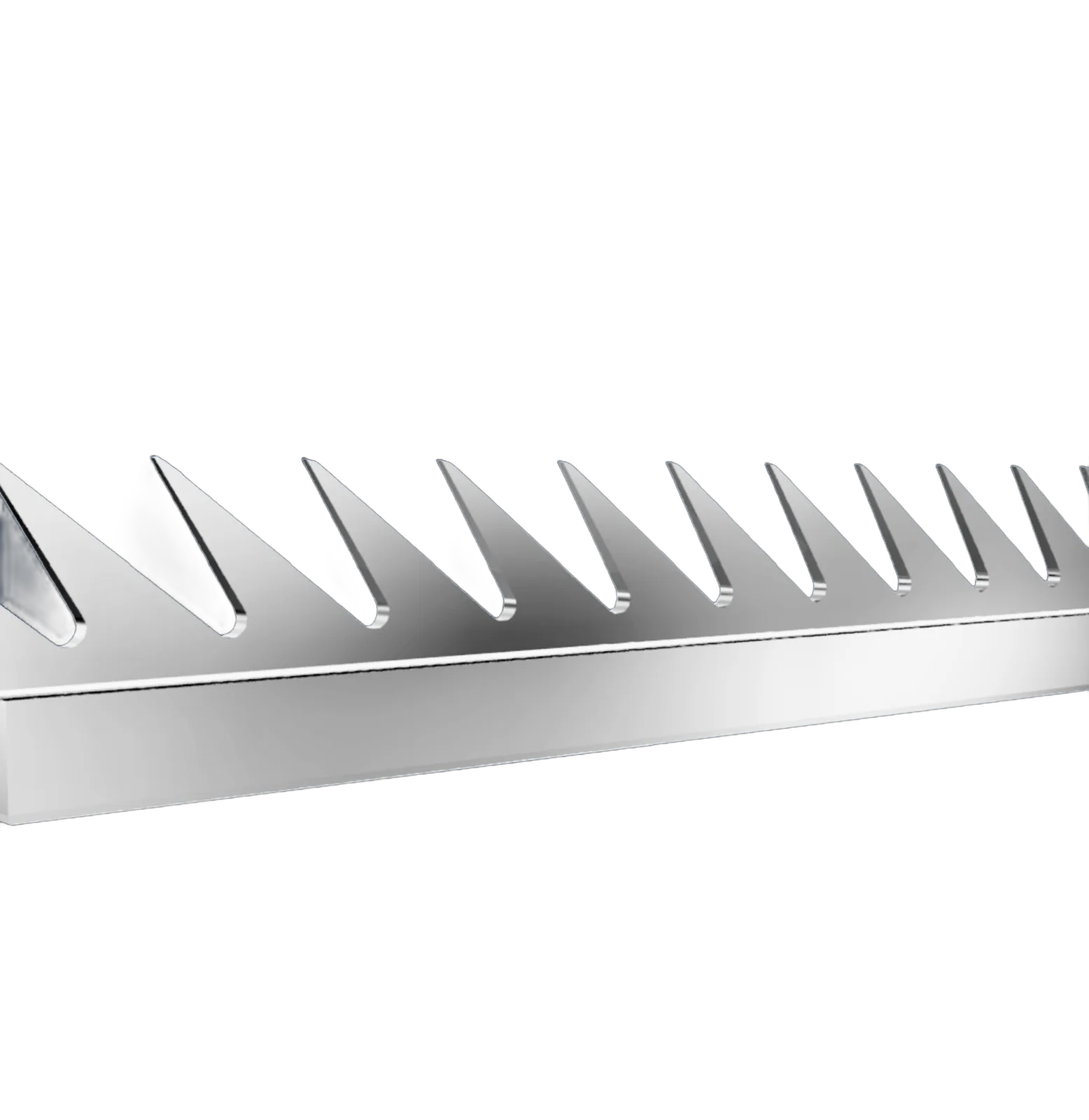
The pre-opener breaks up and loosens the compressed bales, then uses a fan to feed the semi-processed fiber onward. An integrated cast frame keeps it stable, clamp-type feeding opens the fiber evenly, and a strong magnet removes metal debris — the first line of defence for your card clothing downstream. The opening roller can be a claw-tooth or a blade structure, depending on the fiber. Three widths: 1000mm, 1300mm and 1500mm, at 300–500 kg/h.
3. Blending opener
The blending opener owns your fiber recipe. Once loosened, the fiber is mixed evenly by five beaters, and the operator can set a separate mixing time for each fiber type to hit the target blend ratio. The feeder carries electronic weighing for accurate dosing, and automatic feeding cuts labor intensity substantially. Two widths: 1500mm and 2000mm, at 400–500 kg/h. If you blend several fiber types, deniers or colours, this is not the machine to economise on.
4. Fine opener
The fine opener is the main opening step: it takes the pre-opened fiber, tears it finer, blends it more thoroughly, then fans it forward to batt formation. The frame is an integrated CNC-machined bending structure, feeding is clamp-type, a magnet catches metal debris, and the opening roller uses rigid aluminium-alloy carding plates or carding wire — so the roller itself already performs a first pass of combing. Three widths: 1000mm, 1300mm and 1500mm, at 300–500 kg/h. In practice, the openness leaving the fine opener is very nearly the openness the card receives.
5. Chamber blenders — middle and big
A chamber blender both blends and stores, acting as a buffer between the opening machines and the card line. Without it, every uneven bale charge turns into a swing in fabric basis weight.
- The middle chamber blender is controlled by three photoelectric sensors together with a volume-adjustable vibrating feeder that holds the fiber flow steady; the roller surface carries claw nails, with anti-wrap devices at both ends against jams. Two widths: 1500mm and 2000mm.
- The big chamber blender uses a rotary separator to spread fiber evenly through the chamber, with a CNC-machined galvanized interior whose smooth surface keeps fiber flowing cleanly, and a spiked beater. Three chamber volumes: 20m³, 30m³ and 40m³ — a generous reserve that feeds steadily even at high line output.
How poor opening and blending shows up downstream
Defects created here are essentially unfixable later: the cross-lapper only redistributes what the card hands it, and the needle loom only bonds the structure that already exists. The usual symptoms:
- Basis weight (GSM) drifting across the width or along the roll — normally an unsteady fiber feed: too little buffering in the blender, or uneven dosing.
- Neps, thick spots and cloudy patches on the fabric surface: fiber that was not opened enough before carding.
- Uneven tensile strength across the width: bonding fiber unevenly distributed because mixing time or beater configuration was wrong.
- Card clothing wearing fast, teeth breaking unexpectedly, re-clothing intervals shortening: the card is doing the opener’s job.
- The line surging or jamming: an intake that does not feed evenly, often from missing anti-wrap devices or a buffer chamber undersized for the throughput.
When a customer calls us because the fabric “just isn’t even and we don’t know why”, the cause sits in the opening and blending stage far more often than in the needle loom.
Sizing the stage for your line capacity
Machine selection works backwards from the downstream line, not forwards from the bale. Four questions to answer before asking for a price:
- What is your fabric width and card width? The opening stage has to match the card so the fiber stream is neither pinched nor spread too thin — which is why pre-openers and fine openers come in 1000/1300/1500mm while the blending opener and middle chamber blender come in 1500/2000mm.
- How many kilos of fiber per hour does the line consume? The opening stage must supply what the card consumes so the front of the line never becomes the bottleneck; check that figure against the 300–500 kg/h range of the pre-opener and fine opener, and the 400–500 kg/h of the blending opener.
- How many fibers are in the recipe? The more fiber types, deniers or colours, the more you need a blending opener with per-fiber mixing times and electronic dosing.
- How many shifts do you run back to back? Continuous multi-shift running needs a larger buffer so the line does not depend on how promptly an operator charges the next bale — that is the point at which a big chamber blender replaces a middle one.
If you are still planning a new plant, read what machinery a nonwoven factory needs to see where this stage sits among the six machine groups of a full line.
Conclusion
Opening and blending is the least-discussed stage of a nonwoven line and the one that sets the ceiling on everything after it: the card, the cross-lapper and the needle loom can only be as good as the fiber stream they are given. Investing in the right bale opener, pre-opener, blending opener, fine opener and chamber blender — sized to match the downstream line — is the cheapest way to avoid fabric defects that cannot be corrected later.
Vina Nonwoven is the authorized Zhentai representative in Vietnam and supplies the complete opening and blending stage within our nonwoven line catalogue, with installation, maintenance and warranty handled locally. Call our hotline or message us on Zalo — tell us the product you intend to make, your fabric width and target output, and we will spec the stage and quote it, with no charge for the consultation.