BiCo spunbond (bicomponent spunbond) is a spunbond technology that spins each filament from two polymers at the same time, most commonly in a core–sheath structure. The core carries tensile strength and dimensional stability, while the sheath melts at a lower temperature — so it softens first and becomes an adhesive built into the fabric itself. The web therefore bonds without glue or chemical binders, and softness, loft and strength can be tuned per application.
How a bicomponent filament works
Compared with a conventional spunbond line, the difference sits entirely in the spinning section: instead of one polymer stream, two streams are extruded in parallel and merged inside the same spinneret hole, producing a single filament with two distinct material layers.
- Main component — the core, which carries the load. On Huayang’s BiCo air-through line the main component is PET/PP; on the BiCo needlepunch line for automotive the raw materials are PET/COPET.
- Sub component — the sheath, which does the bonding. On the air-through line the sub component is COPET/PE/PP.
- Slot air drawing / slot air drafting — as filaments leave the spinneret, an air stream in a slot draws and quenches them, and they are laid directly into a web on the forming belt.
Because the sheath melts below the core’s melting point, feeding heat in the right window means only the sheath flows while the core stays intact as a filament. That is the whole point of the technology: the fabric gets welded together without losing the load-bearing fibre skeleton inside it.
Bico, bicomponent, or “besico spunbond”?
BiCo is simply an abbreviation of bicomponent. In practice buyers search for it in many forms — bico spunbond, bi-co spunbond, bicomponent spunbond, and quite often “besico spunbond”, a phonetic misspelling. All of them mean the same thing: spunbond made from two-polymer filaments. In manufacturers’ technical sheets you will see it written as bico or as core-sheath compound fibre.
What air-through bonding actually does
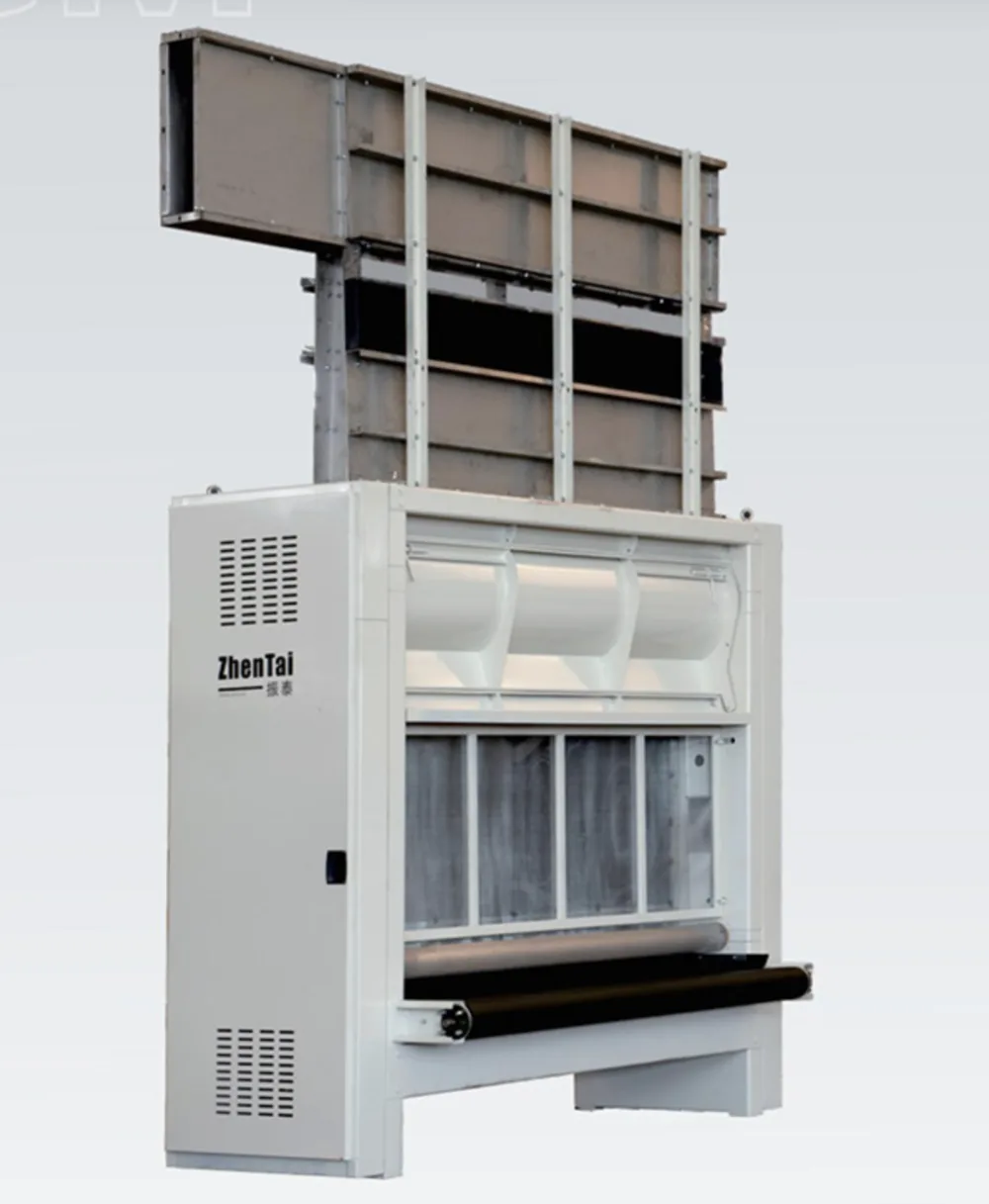
Air-through bonding consolidates a web by blowing hot air through its entire thickness inside a bonding chamber. The hot air softens the sheath of the BiCo filaments, and at every point where two filaments cross, that sheath flows and forms a weld. No roll ever presses on the fabric, so the open structure between filaments survives the bonding step.
On Huayang’s BiCo spunbond air-through line, the result is a fabric with excellent surface smoothness, minimal thickness, high tensile and tear strength and structural stability, together with high water permeability and breathability, significant rigidity, and easy folding and moldability.
Air-through vs. calender bonding vs. needle punching
All three turn a loose web into fabric, but what they do to that web is completely different:
| Criterion | Air-through bonding | Calender bonding | Needle punching |
|---|---|---|---|
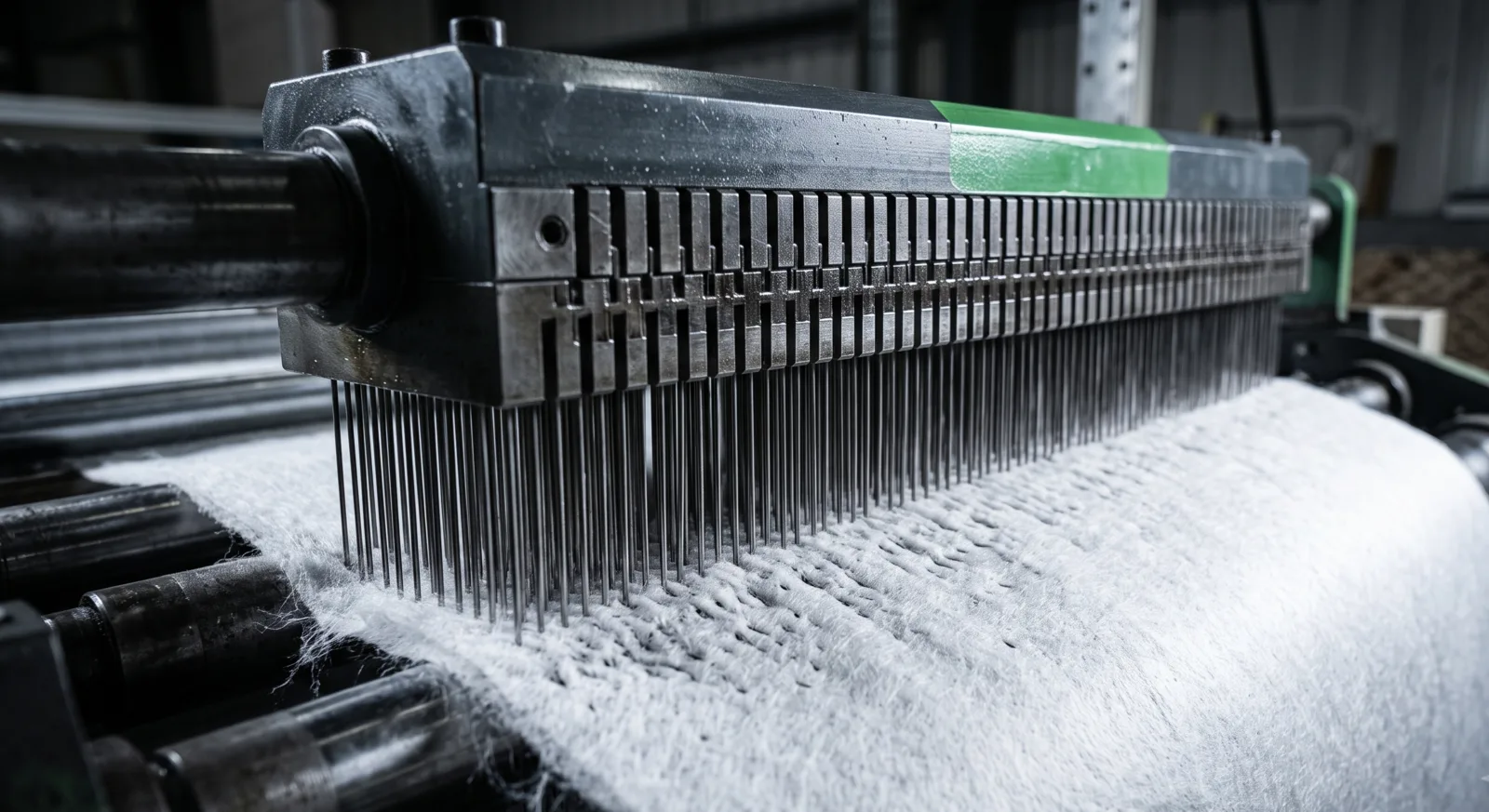
| Bonding mechanism | Hot air through the web; sheath flows and welds at crossovers | Compression between two heated rolls, point-bonded or area-bonded | Barbed needles punch through, entangling fibres mechanically |
| Effect on loft | Structure preserved, no compression | Thinned down, with firm bond points | Needle holes; fibres interlocked through the thickness |
| Fibre requirement | Must include a low-melt component (bico) | Single-component filaments still work | No low-melt polymer needed |
| Fabric surface | Even and breathable | Embossed pattern, stiff at bond points | Needle marks, rougher surface |
| Suitable basis weight | Light to medium | Light | Medium to very heavy |
| Chemical binder | None | None | None |
In short: calender bonding presses, needle punching entangles, air-through bonding welds. If you are at an earlier decision point — still choosing between the two base technology families — read needle punch or spunbond: which technology to choose first.
What BiCo spunbond fabric is used for
- Automotive interiors — the fastest-growing application. Automotive-grade needle-punched felt from BiCo filaments delivers high tensile strength, superior toughness, low weight, good sound absorption and 100% recyclability; its excellent moldability under press-forming makes it the material of choice for battery underbody shields and wheel hub covers on new energy vehicles (EVs).
- Carpet backing — a smooth surface, minimal thickness and high tear strength are exactly the requirements for high-end tufted carpet backing, the target application of the air-through line.
- Hygiene — because the bond is made thermally rather than chemically, air-through bonded BiCo fabric is soft and chemically clean, which suits topsheets and acquisition-distribution layers in diapers and feminine care. The exact configuration depends on each hygiene converter’s requirements.
- Filtration — keeping the open structure through bonding gives a fabric that is both breathable and dimensionally stable, a good base for filter media; filtration ratings have to be set against the medium and efficiency class of each specific order.
Choosing between the BiCo needlepunch and BiCo air-through line
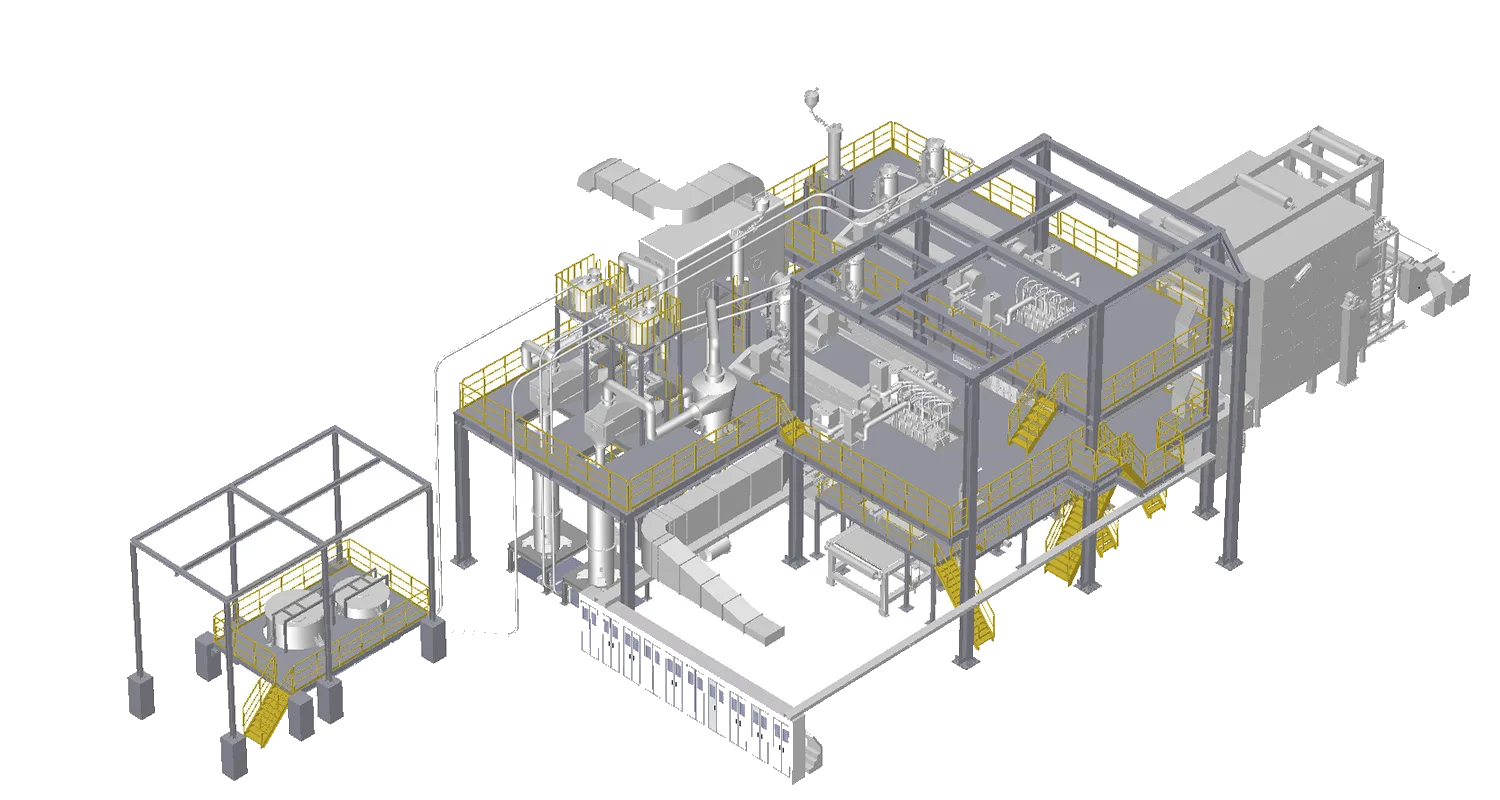
The decision comes down to basis weight and how the fabric has to carry load, not to the machine brand. The two Huayang lines Vina Nonwoven distributes serve opposite ends of the product range:
| Specification | BiCo needlepunch (automotive) | BiCo air-through |
|---|---|---|
| Raw materials | PET/COPET | Main: PET/PP · Sub: COPET/PE/PP |
| Product specification | 600–2000g/m² | 20–300g/m² |
| Work width | 3.0m | 2.4m |
| Denier | 5.0–6.0dpf | Core-sheath compound fibre 4.0dpf; mixed 4.0dpf (PET) + 2.0dpf (COPET) |
| Production speed | 5–50m/min | MAX 200m/min |
| Drawing type | Slot air drafting | Slot air drawing |
| Capacity | 4,000 t/y | 6,500 t/y |
| Target application | EV battery underbody shields, wheel hub covers | High-end tufted carpet backing |
Reading the table is straightforward. If your product is a thick part that must be press-formed and carry load, take the needlepunch branch — the heavy basis-weight range and low line speed are inherent to that class of fabric. If your product is a thin fabric needing an even surface, breathability and volume output, take the air-through branch, where both line speed and annual capacity are markedly higher. The full equipment group sits in the PET Spunbond machinery category.
Conclusion
BiCo spunbond solves something single-component spunbond struggles with: it puts the binder inside the filament itself, so the web can bond thermally without sacrificing its load-bearing skeleton. Air-through bonding exploits that principle most fully — welding evenly through the full thickness without compressing the fabric. Picking the right bonding branch (needlepunch or air-through) at the outset matters more than any later fine-tuning, because it fixes the basis-weight range, the line speed and the annual output your plant can achieve.
Vina Nonwoven is the authorized Huayang representative in Vietnam for both the BiCo spunbond air-through line and the BiCo spunbond needlepunch line for automotive interiors — advising on line configuration by work width and target output, with local installation, commissioning and warranty support. Contact us by hotline or Zalo for advice and a quote.