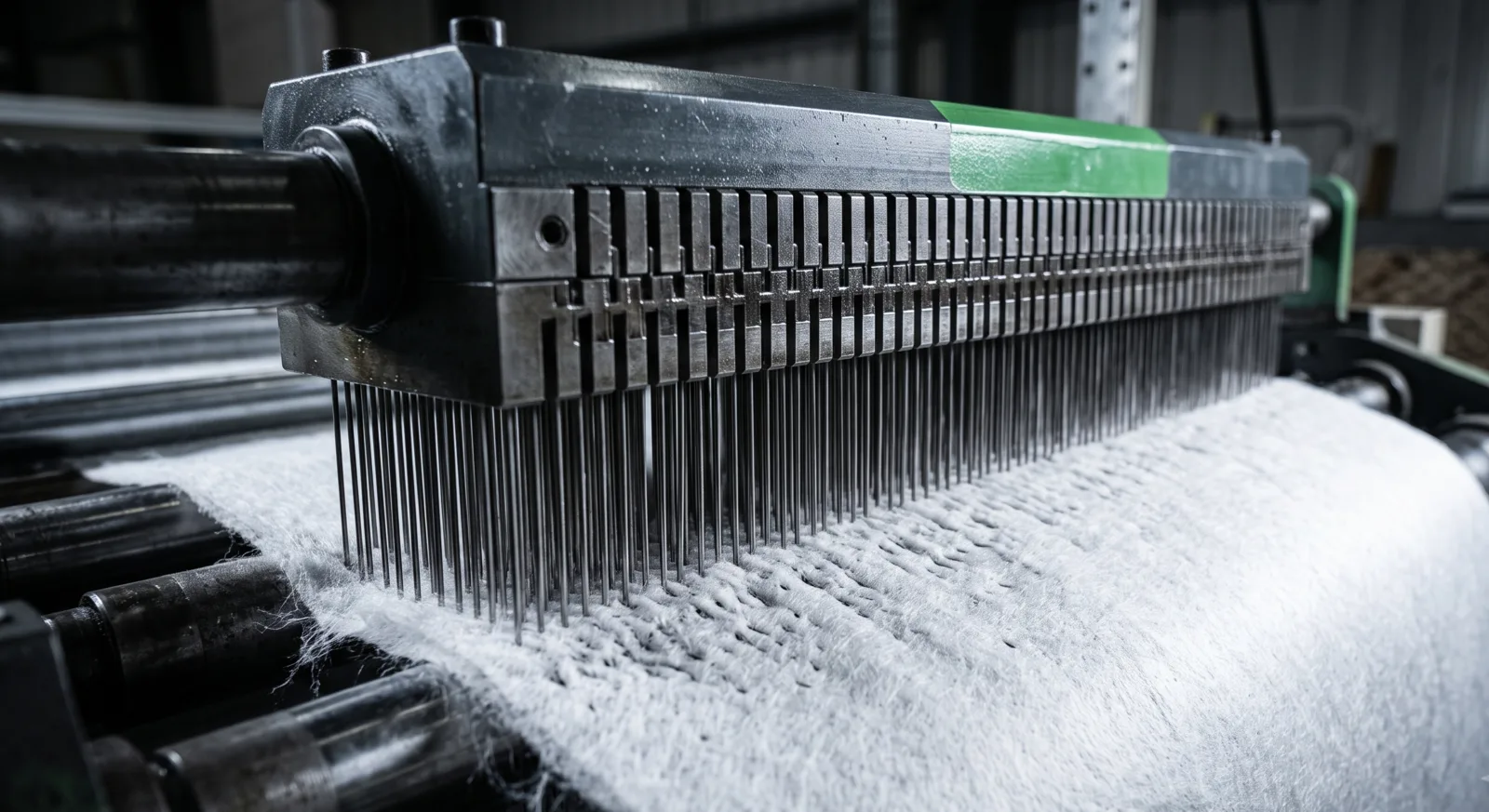
The five most common defects in needle-punched nonwoven fabric are broken or bent needles, a rough surface with large needle holes, fabric tearing, insufficient strength, and strong vibration — most of them tracing back to the wrong needles, worn parts, or poor calibration, and all of them fixable. The needle loom is the central machine in a needle-punch nonwoven production line, so each defect directly affects fabric quality and machine lifespan. Below are the causes and fixes for each one.
Defect 1 – Broken or Bent Needles
Causes:
- Incorrect installation, or use of low-quality needles.
- A poor-quality needle loom with an imprecisely CNC-machined needle board → misaligned needle holes → needles collide and break.
- Needles chosen with the wrong barb depth, barb too deep → picks up too much fiber → needle overload → breaks easily.
- Operating at excessive speed, beyond the design limit.
- A poor ratio between fabric delivery speed and needle board speed → the needle stays too long inside the fiber layer → bends and breaks.
Fixes:
- Select needles with the correct gauge and barb depth for the fiber type and finished-product requirements.
- Prioritize machines from reputable manufacturers, with precisely CNC-machined needle boards.
- Periodically inspect and align the needle board and needle board system.
- Keep operating speed within safe limits.
- Properly adjust line speed and needle board speed to optimize the working ratio.
Defect 2 – Finished Fabric Surface Not Smooth Enough, Large Needle Holes, Uneven Weight Distribution
Causes:
- Needle size too large, especially on the final needle boards in the line → leaves large holes, a rough, non-smooth surface.
- Uneven fiber web coming from the carding machine or cross-lapper.
- Unstable operation of the carding feeder, uneven fiber distribution across the full fabric width → inconsistent web weight.
Fixes:
- Use a smaller needle gauge, especially on the final needle boards, to create a smooth surface.
- Adjust the carding machine and cross-lapper to improve web uniformity.
- Choose a carding feeder with an accurate weight-sensing system to maintain stability.
Defect 3 – Fabric Tearing During Needle Punching
Causes:
- Line speed too fast.
- Needling force too strong.
- Poor-quality fiber raw material.
Fixes:
- Reduce operating speed.
- Adjust the needle loom’s penetration force.
- Use fiber with more stable quality.
Defect 4 – Insufficient Fabric Strength
Causes:
- Needle-punch density not sufficient to create a tight bond.
- Needles with barbs too shallow, unable to carry enough fiber.
Fixes:
- Increase needle-punch density to match the GSM and application requirements.
- Choose needles with deeper barbs, suited to the fiber type and web thickness.
Defect 5 – Strong Vibration, Abnormal Noise
Causes:
- Shaft balancing system out of alignment.
- Worn bearings.
- Machine not securely anchored.
Fixes:
- Inspect and align the shaft.
- Replace the bearings.
- Reinforce the machine base and check the floor’s flatness.
Conclusion
Recognizing common defects early and taking timely corrective action helps businesses maintain consistent fabric quality, extend the lifespan of needles and machinery, and reduce maintenance costs.
Many needle-punching defects trace back to worn needles and wear parts. Vina Nonwoven supplies components & spare parts and complete needle-punch nonwoven lines in Vietnam, along with installation, maintenance, and calibration service. Contact us by hotline or Zalo for advice and a quote.