PSF (polyester staple fibre) is polyester in short, cut-length form — filaments are spun and then cut into staples, commonly 44–102 mm — and it is the raw material behind nonwoven fabric, polyfill wadding, bedding and spun yarn. PSF is produced from PET flakes, including recycled PET bottles, on a staple-fibre production line: the polymer is dried, melted, extruded through spinnerets into filament, then drawn, crimped, heat-set, cut and baled.
The word “staple” means cut-length fibre, as opposed to filament, which is continuous. That distinction matters to a nonwoven plant, because the staple-fibre line is the stage that sits immediately upstream of carding and needle-punching. If your factory currently buys fibre by the bale to feed a carding machine, this is the line that makes exactly that material.
What is inside a staple-fibre production line?
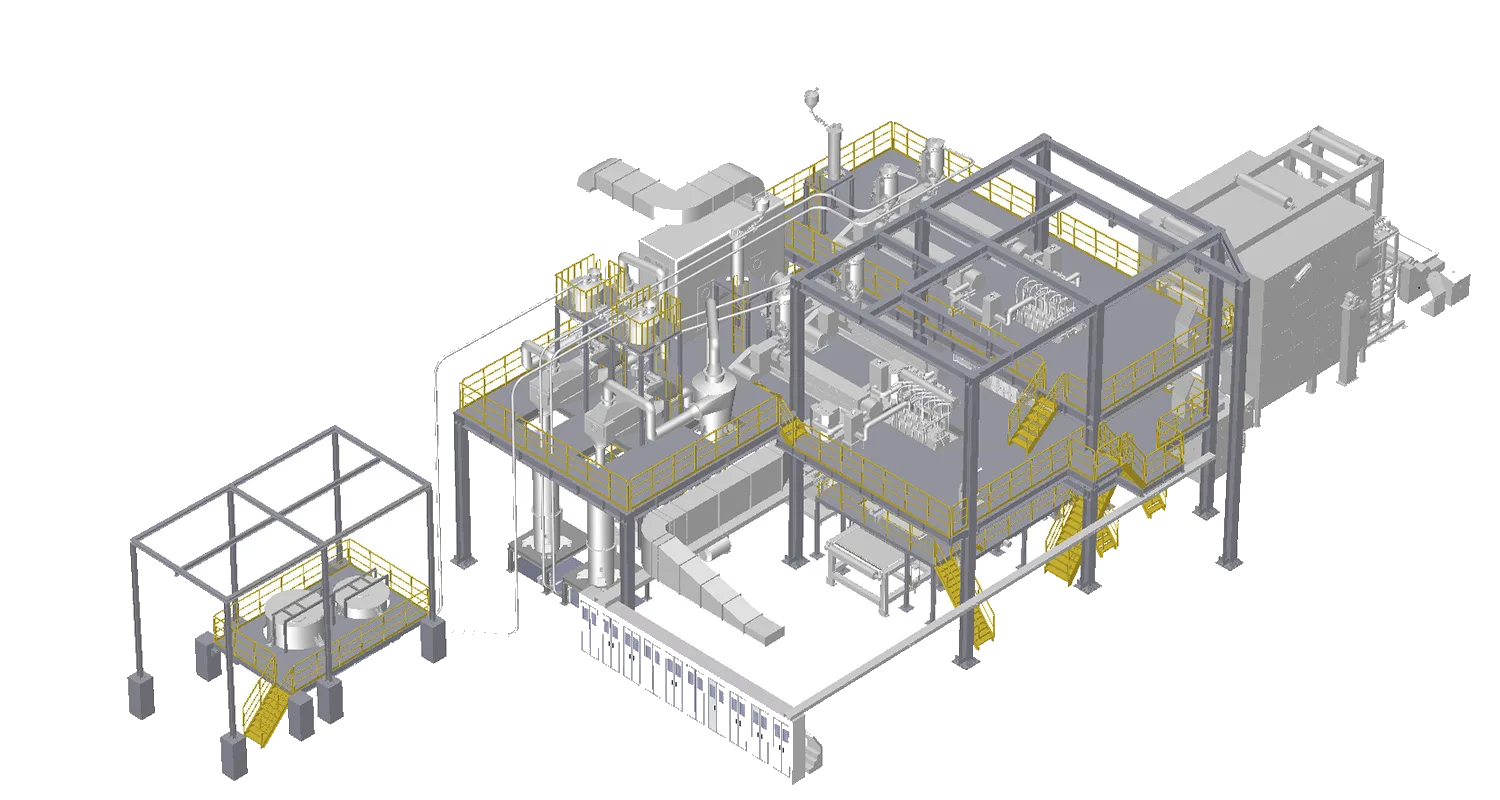
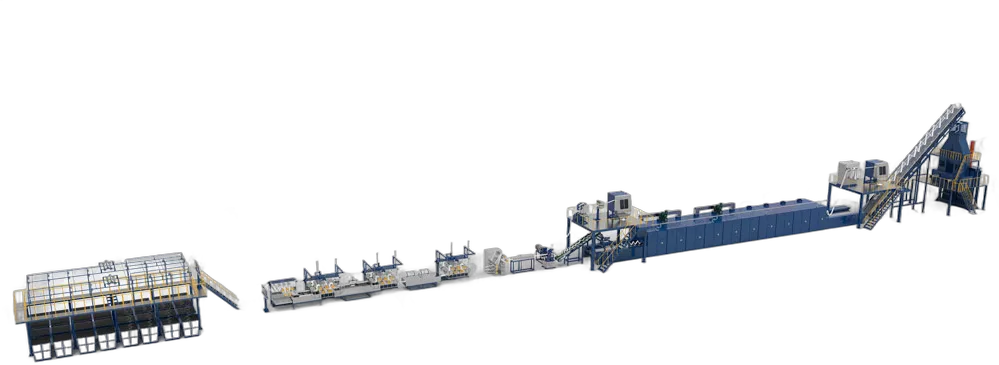
A complete line splits cleanly into two halves.
The spinning line turns polymer into filament: vacuum and crystallizing drying, the extruder, the filter, the spin beam, quenching, the winder, a six-roller drafter with sunflower wheels, and the can traversing unit.
The finishing line turns filament into baled, sellable fibre: the creel stand, the stretcher, the stacker and crimper, the relax and heating setter, and the baler.
A line running recycled PET adds a front end: bottles are sorted, crushed into flakes and alkaline-washed before they reach the dryers — on the PET HT/LE line the flake size is 12–15 mm. Moisture control here is make-or-break — bottle flakes enter the vacuum dryer at ≤4% moisture and must come out below 1%, while the continuous crystallizing dryer brings dry-flake water content down to ≤70 ppm. Residual water hydrolyses the polymer chain during melting, which shows up as constant filament breaks at the spinneret and fibre that misses its tenacity target.
Solid, hollow and conjugated fibre
The polymer can be the same PET while the cross-section is not — and the cross-section is what decides the end market.
- Solid fibre has a solid cross-section and favours tensile strength and dimensional stability. This is the workhorse grade for technical nonwovens: geotextiles, filter fabrics, automotive and speaker felts, and nonwoven carpet.
- Hollow fibre carries a void down the length of the fibre, delivering superior bulk and resilience for the same weight. This is the grade behind polyfill wadding, pillows, cushions, quilts and stuffed toys.
- Hollow conjugated fibre is spun from two polymer components across one cross-section, so the fibre self-crimps and holds its bulk through far more compression cycles. It is the premium grade in the bedding segment.
Yongxing’s solid/hollow conjugated polyester staple fibre (PSF) line runs all three quality grades: Hollow Conjugate Siliconised Fiber, Hollow Non-Conjugate Siliconised Fiber, and Solid Fiber in siliconised or non-siliconised form. The silicone finish is what governs hand feel — the manufacturer’s data sheet states the fibre can be produced soft or with a harsh feel depending on the order.
Four lines, four different fibres
All four lines below belong to the staple-fibre production line family and all four share melt-spinning at their core — but they produce four different fibres for four different markets. No single line covers all of them, and choosing wrong means rebuilding from the spinning stage.
1. The solid/hollow conjugated PSF line is the mainstream choice, fed by PET/polyester waste and post-consumed PET bottles. The fibre runs 1.5–33 Den across cut lengths of 44–102 mm, with a tensile strength of 3.5 to 4.5 gm/Denier, elongation of 40 to 60% and 3 to 5 crimps per cm. Capacity is flexible from 3,000 to 50,000 T/Y, with a typical case being a 60 TPD line. Output feeds pillows, cushions and quilts, automotive nonwoven carpet, polyfill wadding, geotextiles, filter fabrics and acoustic materials.
2. The PP fibre one-step line differs on two fundamentals: the feedstock is virgin PP chips rather than recycled PET, and the whole route is compressed into a single continuous melt-spinning step — molten isotactic PP is metered through spinnerets, air or water quenched, then taken directly into two-stage drawing, relaxing and crimping, cutting out a stage compared with the two-step route. PP fibre has a low specific gravity, so it gives better relative coverage, chemical inertness and low thermal conductivity. Its denier range is unusually wide at 1.5–70 Den, with cut lengths of 25–124 mm, tensile strength above 3.5 gm/Denier and elongation above 70%. Capacity runs 3,000–20,000 T/Y, with a typical case of 20 TPD. Output feeds air and water filters, industrial fabrics, automobile floor carpet, thermal-bonded fabrics and fibre-reinforced concrete (RCC/FRC).
3. The ES and sea-island composite fibre line is a bi-component line, combining two or more non-mixed polymers across the same cross-section in a side-by-side, sheath-core or sea-island structure. Its signature product is sea-island microfiber: Nylon and Co-PET are spun together, then alkaline treatment dissolves the Co-PET “sea” and releases 37 fine-denier Nylon filaments — the “islands” — giving a suede-like soft surface with strong absorbency and wiping performance. Capacity runs 3,000–15,000 T/Y. Output feeds artificial and PU leather, microfiber wipers and high-density fabrics. Note that the manufacturer publishes no detailed fibre data table for this line, so configuration has to be settled through technical consultation around the target fibre.
4. The PET high-tenacity low-elongation (HT/LE) line uses the same recycled PET feedstock as the PSF line but targets the high-strength segment. The difference is a tensile strength of ≥5.7 gm/Denier — well above the 3.5 to 4.5 of ordinary PSF — plus a denier range extending down to 0.9 Den. If your downstream customers need load-bearing fabric with tight dimensional stability, this is the correct line. Capacity runs 3,000–50,000 T/Y, with a typical case of 60 TPD.
Where staple fibre sits in nonwoven production
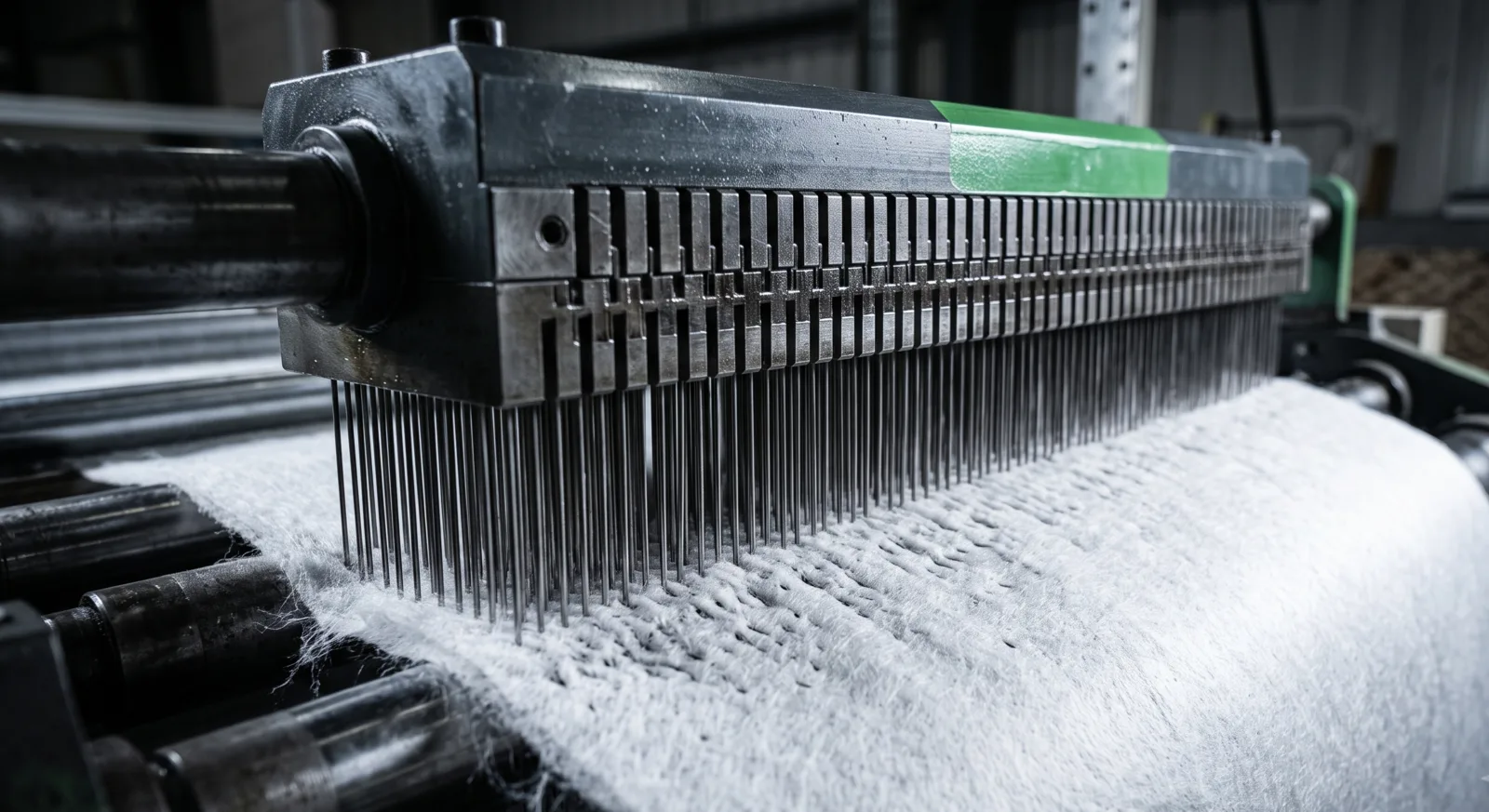
A bale of staple fibre is the starting point of a needle-punch nonwoven line: bales are opened and blended, fed through the feeder into the carding machine to form a web, laid up by the cross lapper, and only then bonded by the needle-punch machine into fabric. The staple-fibre line and the needle-punch line are two halves of one continuous value chain — which has three practical consequences for a buyer.
- Fibre specs dictate behaviour on the card. Denier, cut length and crimp count drive web evenness and card-clothing wear: well-crimped fibre of the right length cards into an even web, while the wrong denier tangles and drives up wire and needle breakage.
- Thermal-bond fibre opens an extra product line. ES and PP fibres feed thermal-bonded fabric — a route that skips needle-punching entirely and uses heat to melt the fibre sheath and fuse the web together.
- Backward integration secures your own feedstock. A nonwoven plant currently buying fibre on the market can invest in a fibre line to make its own PSF from recycled PET bottles, taking control of both input cost and input quality.
Choosing a staple-fibre line: what to weigh
- Settle the target fibre first, then pick the line. Start from who buys your fibre and which denier, cut length and tenacity they specify.
- The feedstock shapes the whole front half. Running recycled PET bottles means adding sorting, crushing, alkaline washing and vacuum/crystallizing drying; running virgin PP chips is far lighter at that stage.
- Match capacity to the sales plan. Ranges of 3,000–15,000, 3,000–20,000 and 3,000–50,000 T/Y are very wide — excess capacity is buried capital, while a shortfall costs you orders.
- Utilities are the commonly missed item. The spin beam is heated by thermal oil 330# or diphenyl and the vacuum dryer runs on steam, so a boiler, a thermal-oil circuit, power, cooling water and wash-water treatment all have to be in place before the machines arrive.
- Floor area. This is a long, two-part line; the vacuum dryer drum alone has an outline of 5145×3005×3184 mm, so lock the plant layout down during the configuration discussion rather than after delivery.
- Total investment follows the configuration — there is no fixed price list. The factors behind the number are broken down in What determines the cost of investing in a nonwoven production line?.
Conclusion
Choosing the right staple-fibre line is a backwards problem: define the fibre grade and the specs your customers demand, and only then choose between PSF, PP one-step, ES/sea-island and PET HT/LE.
Vina Nonwoven is the authorized Yongxing representative in Vietnam across the full range of staple-fibre production lines, with local installation, commissioning, maintenance and warranty. Call our hotline or message us on Zalo for configuration advice matched to the fibre and capacity you need, and a quote.