Quick answer: Nonwoven fabric is a sheet material made from PP, PET or other fibers that are bonded directly together by needles (mechanically), heat or chemicals, without spinning, weaving or knitting. The four main technologies are needle punch, spunbond, meltblown and spunlace. It is light, low-cost and fast to produce, and is used for bags, masks, geotextile, filter media and automotive interiors.
Nonwoven fabric is a sheet material made by bonding fibers directly (mechanically, thermally or chemically), without weaving or knitting them the way traditional fabric is made. Because it skips spinning and weaving, nonwoven fabric is faster and cheaper to produce, and its thickness and strength can be tuned for anything from load-bearing geotextile to lightweight medical masks.
Most content on this topic stops at selling finished nonwoven fabric. This guide goes further: beyond the definition, materials and care, it explains what machines actually make that fabric, because that’s Vina Nonwoven’s business as the Vietnam distributor of needle-punch and PET spunbond production lines.
Definition: what is nonwoven fabric?
Nonwoven fabric is a sheet or roll material formed from a layer of fiber (a fiber web) bonded directly together, instead of interlacing yarn in two directions the way woven fabric is. The input fiber can be staple fiber (short-cut fiber such as PET, PP, viscose, wool, recycled fiber) or continuous filament (fiber spun and bonded on the same line, as in spunbond).
Fibers are bonded together in one of three ways:
- Mechanical bonding: barbed needles punching through the web (needle punch) or high-pressure water jets (spunlace) that entangle the fibers together.
- Thermal bonding: heat and pressure (calendering) partially melt and fuse the fiber, common in spunbond and meltblown. See thermal bonding and drying in nonwoven production.
- Chemical bonding: a binder or resin holds the fibers together (less common among the machine lines Vina Nonwoven distributes).
Other names for nonwoven fabric
You will also see it written as non-woven fabric. In Vietnam and parts of Europe it is called TNT fabric, from the Italian tessuto non tessuto (“non-woven textile”). Technical documents usually name the fabric by the technology that made it: needle punched nonwoven, spunbond, meltblown, spunlace. Using the right name makes it easier to find accurate specifications and suppliers.
What is nonwoven fabric made of?
The raw material determines the fabric’s strength, heat resistance and cost. The common groups:
- Polypropylene (PP). Light, low-cost, does not absorb water, easy to color. The main material for spunbond used in bags, masks, crop covers and the meltblown filter layer.
- Polyester (PET). Stronger and more heat-resistant than PP (melting point around 250 to 260°C, versus around 160 to 170°C for PP), so it is widely used for geotextile, filter media, automotive materials and PET spunbond lines. PET fiber can be recycled from plastic bottles. See what PSF staple fiber is.
- Viscose, cotton and natural fibers. Soft and absorbent, used for wet wipes, cotton pads and medical supplies, usually with spunlace.
- Recycled textile fiber and blends. Used in needle-punch fabric for carpet underlay, acoustic insulation and padding, lowering raw-material cost.
In practice, plants often blend several fiber types at the opening and blending stage to reach the exact properties the end product needs.
Types of nonwoven fabric by production technology
There are four main technologies, each giving fabric with different properties and applications:
1. Needle punch
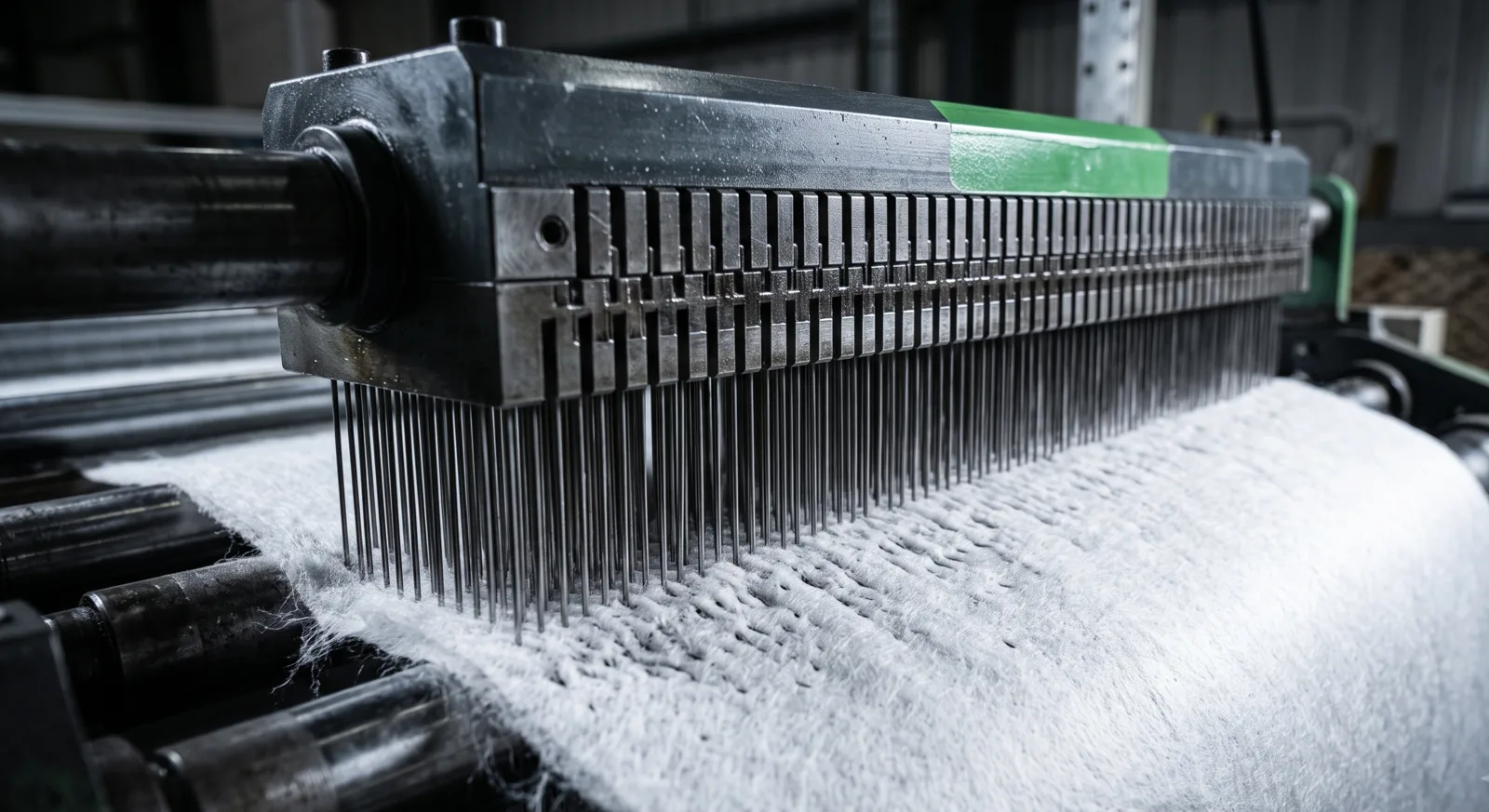
Fiber is bonded mechanically: tens of thousands of barbed needles punch through the fiber web, entangling the fibers so the layers lock together, with no chemicals needed. This gives thick, strong, high-tensile fabric. It’s the most common technology for geotextile, carpet, industrial filter fabric and automotive materials. See the full breakdown in The needle-punch production process.
2. Spunbond
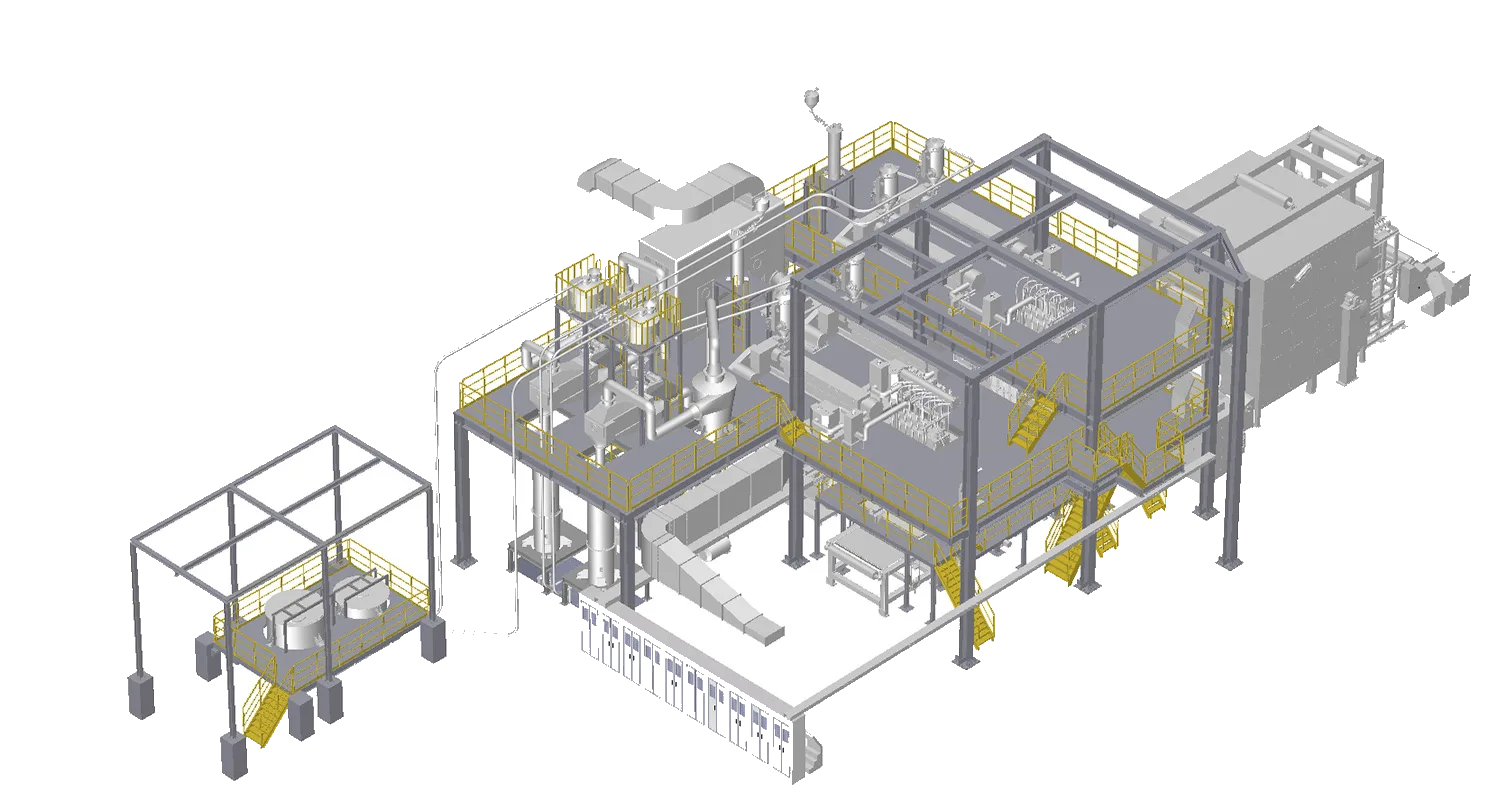
Polymer (PP or PET) is melted, extruded into continuous filaments, laid directly into a web and thermally bonded on the same line, skipping the carding and cross-lapping steps used in needle punch. This gives thin, even fabric at very high output. It is also the fabric used to sew nonwoven bags; see what a nonwoven bag is. The line construction is covered in The spunbond production line: construction and operating principle.
3. Meltblown
Molten polymer is blown by high-velocity air through a fine die, producing ultra-fine (micro) fibers. Meltblown fabric filters fine dust and bacteria well, and is commonly used as the filter layer in medical masks, layered with spunbond to form an SMS (spunbond–meltblown–spunbond) structure.
4. Spunlace (hydroentanglement)
The fiber web is bonded using high-pressure water jets instead of needles or heat, giving a soft fabric closer in feel to traditional woven cloth. Commonly used for wet wipes, medical fabric and single-use skin-contact products. See what spunlace is.
If you’re weighing the two most common technologies for industrial production, see the detailed comparison in Needle-punch vs spunbond: which technology should you choose?
How nonwoven fabric is actually produced (needle-punch line)
Unlike guides that describe nonwoven fabric only at a conceptual level, here’s the real machine chain a needle-punch line (the most common technology) runs in material-flow order. The short video below follows one fiber through the line, from opening and carding to needle punching:
- Bale opening & blending. Virgin or recycled PET/PP fiber is opened from compressed bales, cleaned of impurities and blended evenly before carding. See fiber opening and blending machinery.
- Carding machine. Fiber is carded (parallelized and separated) into thin, even fiber webs. Carding quality depends directly on the card clothing / carding wire, a wear part that needs periodic replacement. The carding feeder at the input also determines how stable the GSM stays; see the feeder unit in a needle-punch line.
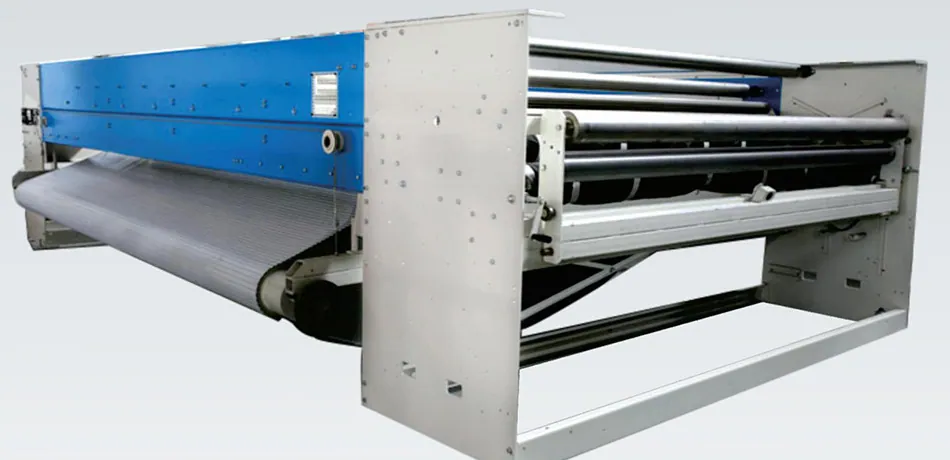
- Cross lapper. Layers the fiber web in a zigzag pattern to reach the target weight (GSM) and width, keeping the web even across the fabric. See the role of the cross lapper.
- Needle loom. Tens of thousands of barbed needles, mounted on needle boards, punch through the web, entangling fibers to mechanically bond the layers together. This stage creates the characteristic strength of needle-punch nonwoven.
- Calender / thermal finishing. May apply heat, pressure or coating to increase strength, smooth the surface, or finish the fabric for its target application.
- Winder. The stabilized fabric is wound into large rolls, ready for further processing or sale.
With spunbond, the carding – cross-lapping – needle-punch stages are replaced by continuous filament spinning and thermal bonding on the same line, giving higher output but thinner fabric.
If you’re planning an investment, What machines do you need to open a nonwoven workshop? covers all 6 machine groups in a complete line, and What determines the cost of investing in a nonwoven line? explains the cost factors.
Advantages and disadvantages of nonwoven fabric
Advantages
- Fast, low-cost production. Skipping spinning and weaving, one line goes straight from fiber (or polymer pellets) to a roll of fabric, so cost per square meter is lower than woven fabric.
- Highly customizable. Weight (GSM), thickness, stiffness and color can all be tuned through the raw material, the number of lapped layers, needling density or calender temperature.
- Light and breathable. The open fiber structure lets air and moisture through, which suits masks, protective wear and crop covers.
- Engineered functions. Filtration, drainage, separation, acoustic and thermal insulation: functions ordinary woven fabric struggles to deliver at the same cost.
- Easy to print and convert. Spunbond has an even surface and uniform color, so it prints, cuts and heat-seals into bags easily.
- Uses recycled feedstock. Needle-punch lines can run recycled PET fiber from bottles or fiber reclaimed from textile waste.
Disadvantages
- Lower strength than woven fabric in light grades. Thin spunbond tears under sustained tension or abrasion and cannot replace woven fabric in durable apparel.
- Limited heat resistance. PP softens at around 160 to 170°C and cannot be ironed or tumble-dried; high-temperature uses need PET or heat-resistant fibers.
- UV ageing. PP without UV stabilizers turns brittle and breaks down in prolonged sunlight; outdoor fabrics such as geotextile need UV-stabilizing additives.
- Directional strength. The fabric is usually stronger in the machine direction (MD) than the cross direction (CD) unless it is lapped and treated for balance.
- Still a synthetic plastic. PP and PET do not biodegrade like cotton; sustainability depends on reuse and recycling.
Applications of nonwoven fabric
- Geotextile. Thick, strong, water-permeable needle-punch nonwoven separates material layers, reinforces soil, and filters and drains water in roads, dikes and landfills. See woven vs needle-punched nonwoven geotextile and Which line makes geotextile fabric?
- Automotive. Nonwoven fabric forms interior lining, floor mats and acoustic/thermal insulation inside vehicles, usually requiring the high mechanical strength that needle punch delivers.
- Medical. Masks, protective gowns and surgical drapes, mostly made with spunbond combined with meltblown (SMS structure) or spunlace for skin-contact products.
- Packaging and bags. PP spunbond nonwoven bags replace plastic film bags in retail, gifting and branded promotion.
- Agriculture. Crop covers, row covers, weed control and moisture retention, usually light PP spunbond with UV additives.
- Industrial filtration. Dust, air and oil filters need a thick, porous fiber structure, typically made by needle punch or meltblown depending on the particle size to be filtered.
- Home furnishing. Upholstery, carpet and decorative lining fabric make use of the thickness and hand-feel of needle-punch nonwoven or the softness of spunlace.
Quick comparison with traditional woven fabric
| Criteria | Nonwoven fabric | Traditional woven fabric |
|---|---|---|
| How structure forms | Direct fiber bonding (mechanical/thermal/chemical) | Yarn spun then interlaced in 2+ directions (weaving/knitting) |
| Number of stages | Fewer (skips spinning and weaving) | More (spinning, sizing, weaving, finishing) |
| Production speed & cost | Faster, lower cost per meter | Slower, higher cost |
| Directional strength | Often skewed toward machine direction (MD) unless treated | More balanced across both weave directions |
| Thickness/GSM flexibility | Very flexible via layering and needling density | Limited by weave pattern and yarn density |
| Typical applications | Geotextile, filtration, single-use medical, automotive, bags | Apparel, premium home textiles, long-life fabric |
Using and storing nonwoven fabric
- Keep it away from heat. Do not iron directly, tumble-dry or store near flame; PP softens at around 160 to 170°C and burns easily.
- Avoid long, harsh sun exposure for fabric without UV additives, so it does not turn brittle.
- Clean gently. For spunbond bags and items, hand-wash in cold water, avoid hard wringing and dry in the shade.
- Store rolls somewhere dry, raised off the floor and covered from dust, without heavy loads that deform the roll.
- Match the fabric to the job. Weight (GSM) and technology decide performance: use needle punch for load-bearing and drainage, spunbond for light, printable fabric.
Conclusion
Nonwoven fabric is a material made by bonding fiber directly, without weaving or knitting, mostly from PP and PET, with four main technologies: needle punch, spunbond, meltblown and spunlace, each suited to a different group of applications. It wins on cost, production speed and customization, in exchange for lower strength and heat resistance than woven fabric in light grades. Understanding the right material, technology and production process helps a business choose the right line for the product it wants to make, rather than looking only at the finished fabric.
Vina Nonwoven is the Vietnam distributor of needle-punch lines (Zhentai) and PET Spunbond lines (Huayang), the two most common nonwoven production technologies, with spare parts, installation and maintenance handled locally. Contact us by hotline or Zalo for advice on the technology that fits your product and a quote.